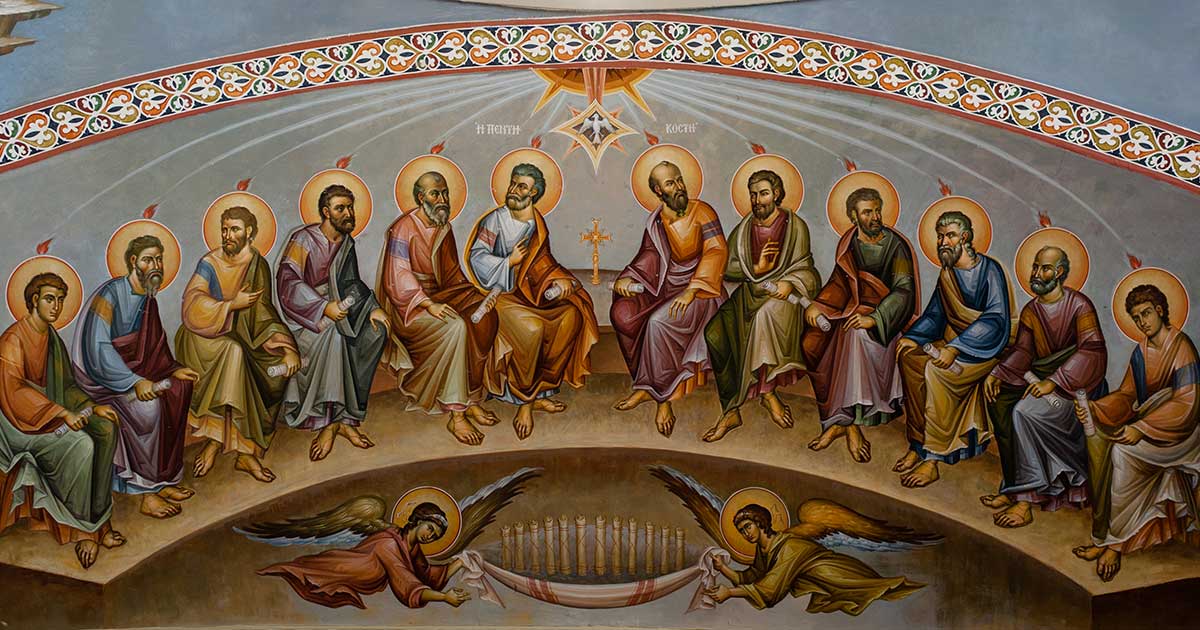
The history of the Orthodox Church actually begins in the Acts of the Holy Apostles, with the Descent of the Holy Spirit: When the day of Pentecost had come, they were all together in one place. And suddenly a sound came from heaven like the rush of a mighty wind, and it filled all the house where they were sitting. And there appeared to them tongues as of fire, distributed and resting on each one of them. And they were all filled with the Holy Spirit and began to speak in other tongues, as the Spirit gave them utterance (Acts 2:1-4). As the text further tells us, on that same day, after St. Peter had preached to the gathered A people, those who received his word were baptized, and there were added that day about three thousand souls (Acts 2:41), thus constituting the first Christian community at Jerusalem.
This first community of Christians, headed by St. James, the Brother of the Lord the first Bishop of the city was later scattered by the persecutions which followed the stoning of the first martyr of the Christian Church, St. Stephen: And on that day a great persecution arose against the church in Jerusalem; and they were all scattered throughout the region of Judea and Samaria, except the Apostles (Acts 8:1).
At the same time, faithful to the Lord's command to go...and make disciples of all nations, baptizing them in the name of the Father and of the Son and of the Holy Spirit (Matt. 28:19), the Apostles went out and preached wherever they went, first to the Jews and then to the Gentiles, so that in a surprisingly short time, Christian communities had sprung up in all the main centers of the Roman world and beyond. Their exploits are recorded in the Acts, as well in the inner tradition of the Orthodox Church.
"We knew not whether we were in heaven or on earth, for surely there is no such splendor or beauty anywhere upon earth. We cannot describe it to you: only this we know, that God dwells there among men"
Emissaries of Prince Vladimir of Kiev
The goal of the Christian's life on earth is salvation in our Lord Jesus Christ and, at the same time, communion with God. The means for this communion is prayer, and through his prayer the Christian is joined in one spirit with the Lord (I Cor. 6:17). Prayer is the focal point and foundation of spiritual life and the source of salvation. Without prayer, as St. John Chrysostom says, there is no life in the spirit. Without prayer man is deprived of communion with God and can be compared to a dry and barren tree, which is cut down and thrown into the fire (Matt. 7:19).
In prayer, the Christian concentrates together all his spiritual acts. Prayer draws down to him the grace of God and is an invaluable instrument of spiritual defense in the Christian's struggles against the sinful passions and vices. By prayer our thoughts, desires and deeds are sanctified, for he who prays receives the blessing of the Lord on his deeds, for, as Holy Scripture tells us, unless the Lord builds the house, those who build it labor in vain (Ps. 127:1). Nothing so helps us to grow in virtue as our pure and pious prayers to God. Thus it was the shared opinion of all the Holy Fathers that prayer is the mother of virtues. By repeated and fervent prayer, man is made more worthy of God's mercy and more capable of receiving the gifts of grace which God, by reason of His infinite goodness, is already to bestow on us out of His immeasurable bounties.
In prayer, the Christian prays not only for himself, but for all men, for we all are the children of God. We must pray for the salvation of our neighbor just as we pray for our own salvation, and the best means of correcting our neighbor is to pray for him, because prayer for our neighbor has far greater effect than denunciation of his sins. In addition, we pray not only for the living, but also for the departed, that God may forgive them their sins and grant them repose in the heavenly mansions of the righteous.
These Truths We Hold
The information above was taken from "These Truths We Hold - The Holy Orthodox Church: Her Life and Teachings". You can find the book Saint Vladimir Semanary Press here.
-
Location